Standards Check

Ace your standards check.

Data-driven preparation for your DVSA assessment, not guesswork.

Free for instructorsNo card neededEvery feature included

Key benefits

01

All 17 DVSA competencies

Track every competency the examiner scores you on, from lesson planning through risk management to teaching and learning strategies.

Improvement trends over time

Score yourself regularly and watch your progress. Spot which competencies are improving and which need more attention before the real thing.

Pass rate monitoring

Track your pupils' first-time pass rates, average driving faults, and serious faults per test. Your pupils' results reflect your teaching quality.

Business health dashboard

See lessons booked percentage, cancellation rates, and teaching metrics side by side. A healthy business supports better teaching.

A separate area for PDIs

Trainee instructors get Part 1 theory practice and a Part 2 and 3 training log. The standards check tools are for qualified ADIs.

Standards check history log

Keep a permanent record of every standards check with scores, examiner notes, and your own reflections. See how far you've come.

Track every competency that matters

The DVSA standards check assesses 17 specific competencies across three core areas. Orbit lets you score yourself on each one after every lesson, building a clear picture of where you excel and where you need to focus.

  • Self-score all 17 competencies after each lesson
  • Competencies grouped by lesson planning, risk management, and teaching strategies
  • Visual dashboard showing your strongest and weakest areas
  • Examiner interaction scoring to prepare for the assessment day
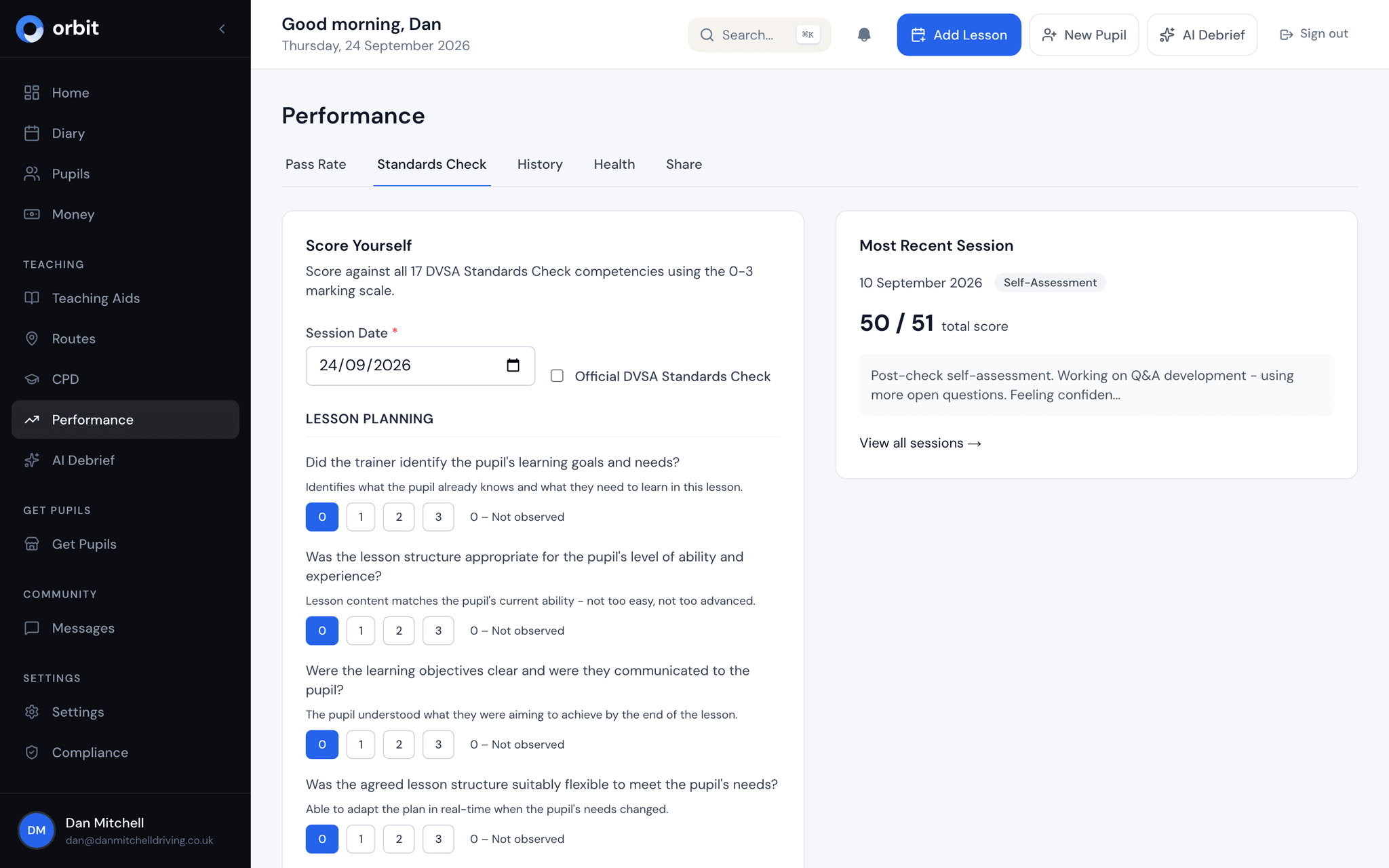
DVSA Standards Check scorer

Your pupils' results tell your story

Your teaching quality shows up in your pupils' test results. Orbit tracks every test outcome and calculates the metrics that matter - so you have hard evidence of your effectiveness, not just a feeling.

  • First-attempt pass rate calculated automatically
  • Average driving faults and serious faults per test
  • Month-by-month trend over the last 12 months
  • Examiner action (none, verbal or physical) recorded with each test

Standards check tracker on DVSA's four triggers

DVSA uses four indicators from your pupils' tests over a rolling 12 months to decide when to call you for a standards check. Orbit works them out from your own records, so you see a problem coming instead of hearing about it in a letter.

  • Average driving faults, serious faults, physical examiner action and pass rate, each against DVSA's trigger
  • How many of the four you've hit, and how much room is left on each
  • When your oldest tests drop out of the 12-month window
  • Flags for gaps in your records, such as passed pupils with no test on file
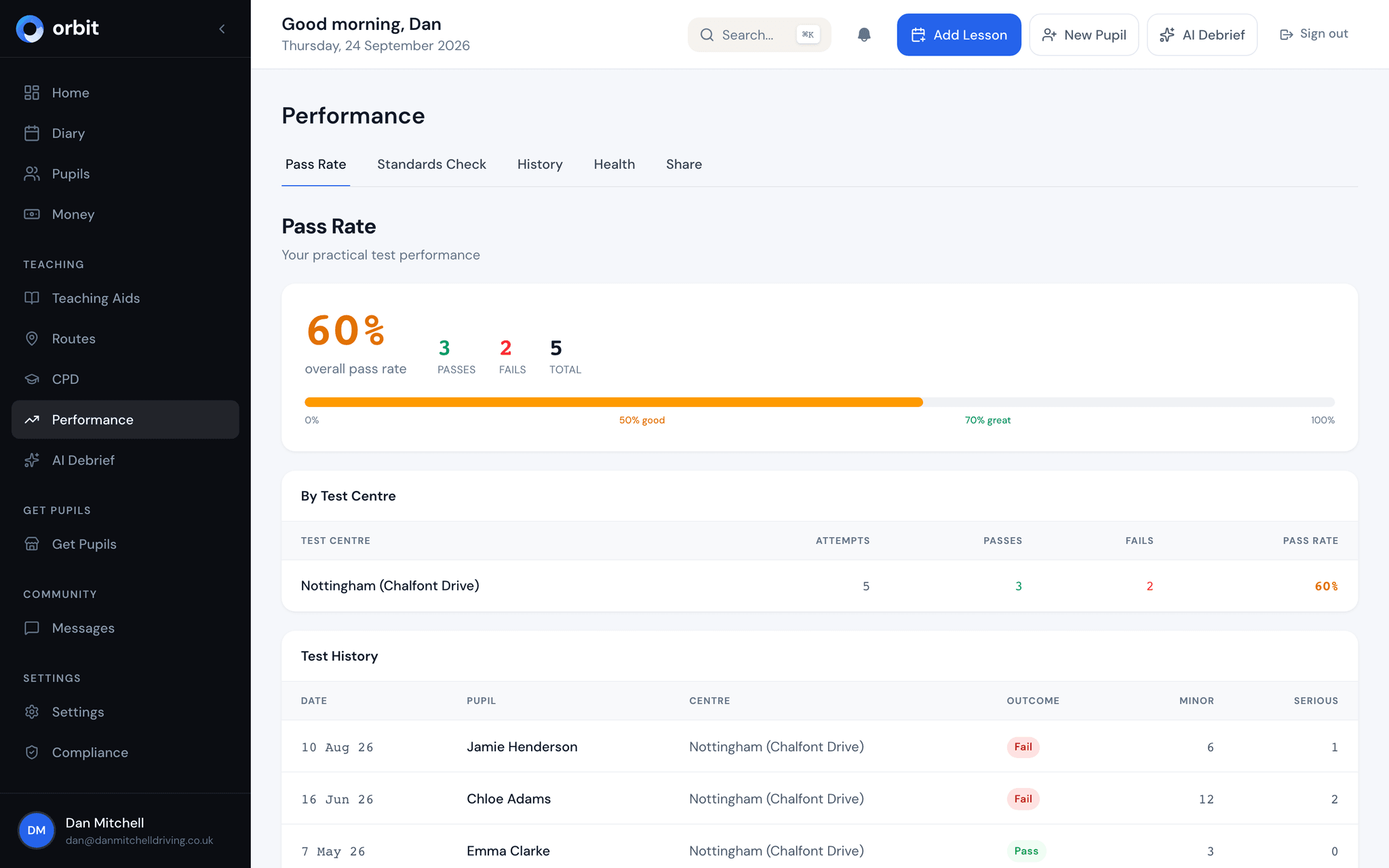
Track your pass rate performance

Continuous improvement, not last-minute panic

The best ADIs don't cram for their standards check - they build reflective practice into every lesson. Orbit's continuous tracking means you're always prepared, whether your next check is four years away or four weeks.

  • Reflective learning prompts after each lesson
  • Historical trend charts showing your development over months and years
  • Trainee (PDI) accounts get a Part 2 and 3 training log instead
  • Export your development log as evidence for CPD
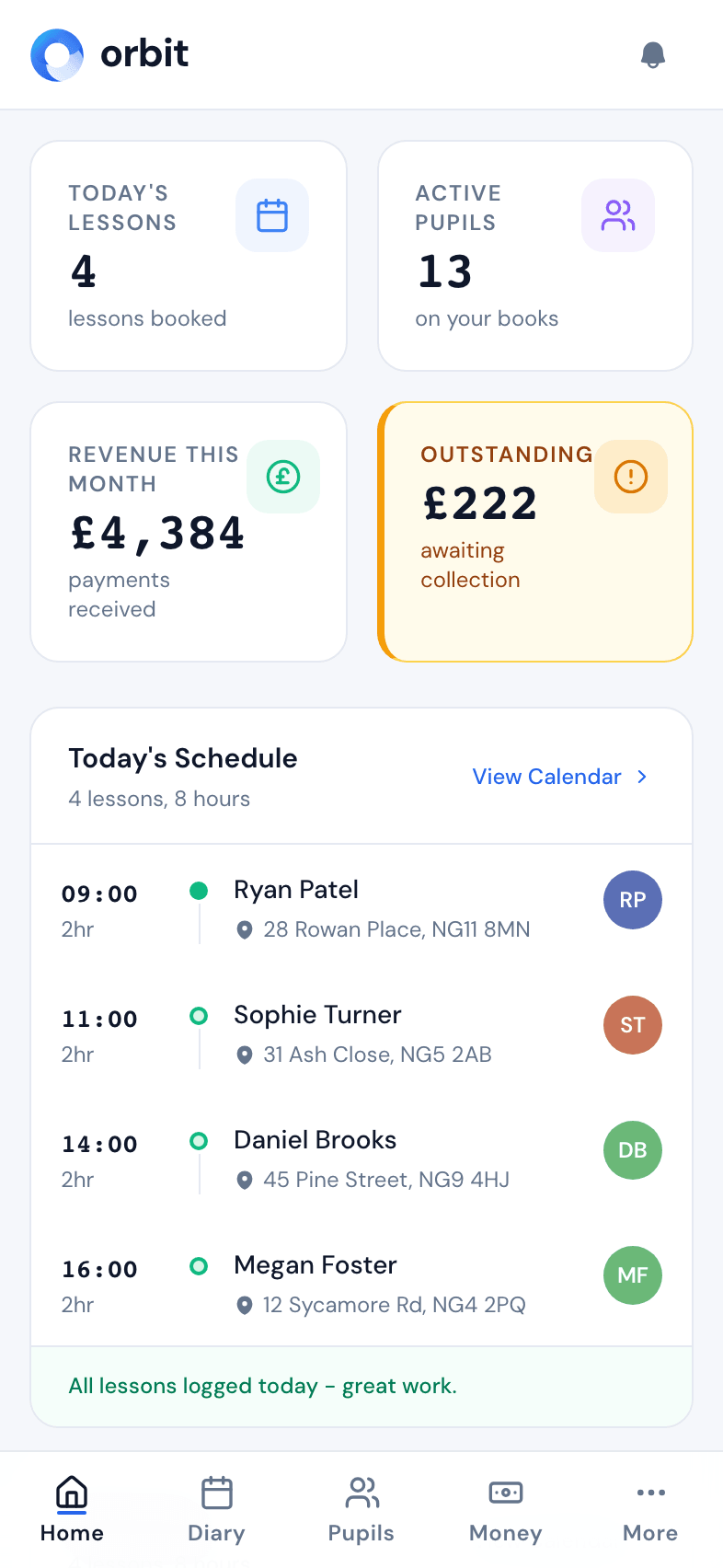
Performance metrics on mobile
FAQ

Questions & answers

What is a DVSA standards check?
A standards check is the DVSA's assessment of your teaching ability as an approved driving instructor. An examiner sits in on one of your lessons and scores you across 17 competencies covering lesson planning, risk management, and teaching and learning strategies. You need an overall grade of A or B to maintain your ADI registration.
How often do I need a standards check?
GOV.UK says you usually have a standards check every 4 years, but in September 2026 DVSA said there's no fixed time for when you might be called, and that most ADIs didn't get one in 2024/25. It isn't tied to your registration renewal, and DVSA can call you at any time. Orbit helps you stay prepared year-round so you're never caught off guard.
How is the standards check marked?
On DVSA's standards check form (ADI SC1), which uses the same 17 competencies and grade bands as the ADI Part 3 marking sheet. The competencies sit in three groups: lesson planning (4), risk management (5) and teaching and learning strategies (8). Each scores 0 (no evidence) to 3 (demonstrated in all elements). GOV.UK's bands: 43 to 51 is grade A, 31 to 42 grade B, 0 to 30 a fail, and 7 or less in risk management is an automatic fail. Our ADI Part 3 guide lists every competency, and the free standards check calculator totals a practice score.
What does Orbit track?
You score yourself across the three standards check areas (lesson planning, risk management, and teaching and learning strategies) after lessons, and Orbit keeps the history so you can spot trends and keep a record of every real standards check.
Can I use this for PDI training?
No. The standards check tools are for qualified ADIs, so they're hidden on trainee (PDI) accounts. PDIs get their own area instead: ADI Part 1 theory practice and a Part 2 and Part 3 training log for the hours you do with your trainer.
How does pass rate tracking work?
Orbit calculates your pupils' first-attempt pass rate, average driving faults, average serious faults and a month-by-month trend from the test results you log. These metrics feed into your business health dashboard alongside lesson utilisation and cancellation rates, giving you a complete picture of your teaching effectiveness.
What is the standards check tracker?
DVSA can write asking you to book a standards check when your pupils' car test results over a rolling 12 months hit three or more of its four triggers: an average of 6 or more driving faults, 0.55 or more serious faults, physical examiner action on 10% or more of tests, or a pass rate of 55% or lower (the triggers apply once you have 5 or more tests in the 12 months). Orbit's tracker shows each of the four against your own results, how many you've hit, how much room is left, and when your oldest tests drop out of the 12 months. It also flags gaps in your records, such as pupils marked as passed with no test on file. Log whether the examiner took verbal or physical action on each test so the figures are complete. Orbit records serious and dangerous faults together, so its serious-fault figure can read slightly higher than DVSA's.

Prepare with confidence

Start tracking your competencies today. Free for instructors, no card needed.

Create your free account
Free for instructorsNo card neededEvery feature included